*Source: Based on Q1 2026, IQVIA Syndicated Prostate Cancer Tracker for US market conducted between January – March 2026.
THIS INFORMATION DOES NOT IMPLY SAFETY OR EFFICACY OF ANY PRODUCT: NO COMPARISONS SHOULD BE MADE. New patients are defined as patients who have been on their current treatment for 3 months or less based on patient chart audit and have not been switched from any other androgen receptor blockers in this period.
†ADT refers to a medical or surgical treatment that lowers testosterone.
NUBEQA® is proven to effectively treat certain types of advanced prostate cancer.
In two clinical studies (see Clinical Trial 1 and Clinical Trial 2 below), NUBEQA delivered proven results.
You and your doctor can determine if taking NUBEQA with or without chemotherapy† may be right for you.
*ADT refers to a medical or surgical treatment that lowers testosterone.
†Chemotherapy=docetaxel.

CLINICAL TRIAL 1: NUBEQA + ADT
Radiographic progression-free survival was evaluated in 446 men taking NUBEQA + ADT, compared to 223 men taking ADT alone.
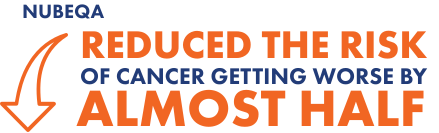
In a clinical study, NUBEQA + ADT reduced the risk of progression‡ by 46% compared to ADT alone (median§ not reached vs 25 months).
At the time of analysis, 29% (128 out of 446) of men taking NUBEQA + ADT had cancer worsening via scans or were no longer living compared to 42% (94 out of 223) of men taking ADT alone.
‡rPFS is measured by the cancer worsening via scans or the participant no longer living.
§Median is the middle value in a set of numbers, not the average.

More about this clinical study
NUBEQA was added to ADT in men with metastatic prostate cancer that responds to ADT. NUBEQA results were compared to results in men taking ADT alone.
Two-thirds of the men in the study took NUBEQA + ADT, while the remaining men took ADT alone.
Characteristics of men included in the study:
669 men between the ages of 43 and 93 were included in the study,
with a median age of 70.


77% (515 men) in the study had stage M1b prostate cancer, meaning their cancer had spread to their bones and may have spread to lymph nodes.

50% (333 men) were still physically able to do things they could before their disease.#

47% (316 men) were restricted in physically strenuous activity but ambulatory and able to carry out work of a light or sedentary nature.#
#According to the Eastern Cooperative Oncology Group Performance Status (ECOG PS) scale.
I've always loved music and still have the joy for it that I had many years ago.
- Dr. Tom Green, retired urologist and
NUBEQA patient since 2022
Adding NUBEQA to ADT also delayed pain progression¶


It took significantly longer for pain to get worse for men who took NUBEQA + ADT compared with men who took ADT alone.
¶Pain progression was defined as:
- An increase of 2 or more points of the worst pain felt in a 24-hour period, measured twice in a row, 4 weeks apart, OR an initiation of opioids for at least 7 days in a row for patients without pain
- An increase of 2 or more points, from a pain score of 4 or more, of the worst pain felt in a 24-hour period, measured twice in a row, 4 weeks apart, OR an initiation of opioids for at least 7 days in a row for patients with pain and a pain score of 1 or more
Patients who used opioids within 4 weeks were removed from the analysis, with 19% removed from the NUBEQA + docetaxel arm and 18% removed from the placebo + docetaxel arm.
CLINICAL TRIAL 2: NUBEQA + ADT + CHEMO
Overall survival was evaluated in 651 men taking NUBEQA + ADT + chemotherapy,** compared to 654 men taking ADT + chemotherapy.

NUBEQA + ADT + chemotherapy extended overall survival by lowering the risk of death by 32% compared to ADT + chemotherapy (median not reached vs 48.9 months).
At the time of analysis, 35% (229 out of 651) of men taking NUBEQA + ADT + chemotherapy were no longer living compared to 46% (304 out of 654) of men taking ADT + chemotherapy.
**Docetaxel is an intravenous (IV) chemotherapy infusion that may be used in combination with NUBEQA. Docetaxel 75 mg/m2 for 21 days for 6 cycles. Note 21 days is one cycle.
More about this clinical study
NUBEQA was added to ADT + chemotherapy in men with metastatic prostate cancer that responds to ADT. NUBEQA results were compared to results in men taking ADT + chemotherapy alone.
About half (~50%) of the men in the study took NUBEQA + ADT + chemotherapy while the other half did not.
Characteristics of men included in the study:
1306 men between the ages of 41 and 89 were included in the ARASENS study, with a median age of 67.

83% (1084 men) in the study had stage M1b prostate cancer, meaning their cancer had spread to their bones and may have spread to lymph nodes.

71% (928 men) were still physically able to do things they could before their disease.||
||According to the Eastern Cooperative Oncology Group Performance Status (ECOG PS) scale. 29% of patients had an ECOG performance status score of 1, meaning they were restricted in physically strenuous activity but ambulatory and able to carry out work of a light or sedentary nature.
I see each day as a gift. I want to make the most of it.
- Randy & Tim
NUBEQA patient since 2024 and
his caregiver, Tim (right)